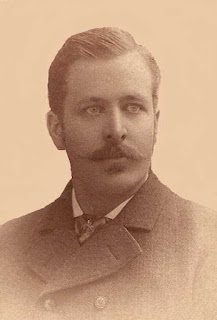
[Scroll Down for Commentary]
Sunday Jan. 1, 1871
I went across the Platt to see Luther Hubbell. I went with Calvin and family. We crossed on the ice. Then I started to go to Calvin's and Luther got lost, and I had to stay all night.
Monday Jan. 2, 1871
We came back to Calvin's. We came through Larimie (?).
Tuesday Jan. 3, 1871
Cal and me cleaned out his well. Drew it very nearly dry.
Wednesday Jan. 4, 1871
I went to town with Luther Hubbell's wagon, but could get nothing to do.
Thursday Jan. 5, 1871
I went over in Iowa. Went to Shaw's, then to Garrett's. Got my dinner, then I went back to Calvin's. Crossed the ice after dark.
Friday Jan. 6, 1871
I fitted up my things and brought my team over to feed at Garrett's. I went to work for Joe Shaw.
Saturday Jan. 7, 1871
I began work today. Chopped four ties and made one.
Sunday Jan. 8, 1871
Sparkes and Burkett and Bill Haynie and Sarah A. Garrett and Louisa and Ellen Rickenbaugh and myself went to Egypt to morning meeting time.
Monday Jan. 9, 1871
I made ties today for Shaw. The timber very scarce.
Tuesday Jan. 10, 1871
Worked in the timber today.
Wednesday Jan. 11, 1871
I finished tie making today. How it rained this afternoon.
Thursday Jan. 12, 1871
It rained and snowed. I did not do anything this day.
Friday Jan. 13, 1871
I was over to see Bill Haynie. We did not do anything.
Saturday Jan. 14, 1871
I drew ties for Emanuel Garrett with his team.
Sunday Jan. 15, 1871
I went to the Post Office, then up to H. C. Gammon's. Got my dinner. George Morrow and wife was there, and Mr. Davis and wife.
Monday Jan. 16, 1871
I got D. Haynie's sled and drew one load of wood.
Tuesday Jan. 17, 1871
I hauled two loads.
Wednesday Jan. 18, 1871
I went to Egypt and got my horses shod.
Thursday Jan. 19, 1871
I loaded a car for Oliver Moore.
Friday Jan. 20, 1871
I drew one load of wood.
Saturday Jan. 21, 1871
I helped Charles Medow load ties. We had a jovial time. There was the two Medows, P. Fletcher, Dave Forsythe, and Jeff the black boy. I got $1.50.
Sunday Jan. 22, 1871
I went to Haynie's Post Office.
Monday Jan. 23, 1871
I went to the timber with Bill Sparke's wagon and broke the tongue out of it.
Tuesday Jan. 24, 1871
I went up to Mr. Armsday's for hay, then from there to another man's and got a load on the wood rack for $1.50.
Wednesday Jan. 25, 1871
I drew two loads of wood.
Thursday Jan. 26, 1871
I drew two loads.
Friday Jan. 27, 1871
I drew two loads.
Saturday Jan. 28, 1871
I drew two loads.
Sunday Jan. 29, 1871
I went to the Post Office, thence to Calvin's. He lives in Morgan's house above Judge William's farm.
Monday Jan. 30, 1871
I drew one load of wood.
Tuesday Jan. 31, 1871
I helped Ben's brother Buck load a car.
COMMENTARY
At first glance, William Cross’s journal might seem like a
monotonous record of daily tasks, but beneath its simplicity lies a
compelling account of survival, resilience, and community on the
19th-century American frontier. His entries reveal the constant
hardships of frontier life—harsh winter conditions, financial
instability, and the relentless physical demands of manual
labor—while also underscoring the significance of community bonds
in an era lacking in social safety nets.
Within just his first month in town, William crosses the frozen
Platte River alone at night, struggles to find steady employment
(January 4), faces equipment failures (January 23), and contends with
scarce timber supplies (January 9), all while losing valuable income
due to uncooperative weather (January 11–12). Yet, amid these
difficulties, his journal captures moments of camaraderie and social
connection. He spends idle rainy days visiting friends, shares meals
at the Gammon home, and escorts young women to Sunday meetings. These
interactions highlight the tightly knit rural community where mutual
support, shared labor, and companionship were essential for both
survival and emotional well-being. His mention of “having a jovial
time” despite backbreaking work (January 21) reflects the humor and
resilience that defined life in small frontier settlements.
William’s journal begins on New Year’s Day, 1871. Having
recently moved from eastern Iowa, he was staying with his friend
Calvin Hubbell’s family in Oreapolis, Cass County, Nebraska, just
across the Platte River from Iowa. The Hubbells, a large family led
by Charles and Charity Hubbell, had nine children—eight sons and
one daughter. What brough William to Nebraska and how he came to know Calvin and his family remains
unclear. Given that the Hubbells had previously lived in Ohio,
Michigan, Iowa, and Wisconsin, it’s possible William had crossed
paths with them during his own travels in the preceding decade.
On that frigid first day of 1871, William accompanied the Hubbells
across the frozen Platte to retrieve Calvin’s older brother,
Luther, from neighboring Mills County, Iowa. Somehow, Luther became
lost, forcing William and the Hubbles to stay the night in Iowa. Upon
their return to Nebraska, William and Calvin spent their days doing
farm chores, including cleaning out the well. By Wednesday, William,
eager to secure work, borrowed Luther’s wagon and set out into
town—only to return empty-handed. Expanding his search, he crossed
the ice again on Thursday to speak with farmers Emmanuel Garrett and
Joseph Shaw about employment. Staying past dinner, he made the
hazardous journey back across the frozen river alone after dark. His
persistence paid off, as the next day he was back in Iowa feeding his
horses at Garrett’s and beginning work for Shaw.
At this time, Mills County’s economy revolved around the
railroad, and Shaw had hired William to produce railroad ties—a fitting
job for the son of a carpenter. From that point on, William spent
nearly every day, weather permitting, chopping timber and crafting
ties for Shaw and other local farmers.
Throughout January, William’s journal notates his interactions with multiple community members, providing a window into the social fabric of 19th century Mills County. Some of these individuals include:
- On Sunday, January 8, William joined Henry Burkett (29), William
Sparkes (26), and Bill Haynie (20) in escorting three young women,
the Garrett sisters, Louisa (18) and Sarah (14), and Ellen Rickenbaugh
(18), to a morning meeting in the nearby community of Egypt. It’s
unclear whether any of the group had an inkling that Ellen
Rickenbaugh would eventually become Mrs. Bill Haynie. Henry Burkett
was the only member of the group who was already married; his wife,
Catherine, had remained home to care for their two young children,
Ruth (1) and Elmer (2). Notably, young
Elmer would
eventually grow up to represent Nebraska for twelve years in the
United States Congress and Senate.
Hugh Gammon
– A well-established farmer with an estate worth over $18,000. His
household included his wife, Sarah Jane (Haynie), and five children.
George Morrow –
A farmer with a property valued at $4,000 and two children.
He and his wife, Mary (Haynie) had two children. Mary Morrow and Sarah Jane Gammon were sisters.
Mr. Davis and his
wife – Possibly either William &
Mary or Edward & Sally. While both men were listed as farmers,
neither owned land, suggesting they may have been tenant farmers.
D. Haynie –
Likely Richard “Dick” Haynie, father of Bill Haynie and uncle to
the Haynie sisters.
Oliver Moore – A small-scale farmer with a
property valued at just $200. He and his wife, Sarah Jane, had no
children.
The two Meadows –
Charles Meadow may have been part of the extended Mills family of
Oak Township or could have been Charles Davis. The other Meadows was likely a brother.
P. Fletcher –
Most likely Bardman Fletcher of neighboring Plattville Township. The initial "P" was likely a transcription error.
Jeff, "the black boy"
– A 17-year-old farmhand who lived and worked on the Fletcher farm. He was one of only four Black
residents recorded in Mills County in 1870.
Mr. Armsday –
Possibly John Armstan of neighboring Glenwood Township. At 54 years old, it
would be fitting for William to address him as "Mr."
Judge William –
Questionably, William F. William, a young farmer. As there is no record of him
serving as a judge, the title may have actually been a nickname.
Ben and Buck –
Their identities remain unknown. There were multiple men named Ben
in Mills County, but none have been confirmed to have a brother or
son named Buck.
Dave Forsythe – Unidentified.
Stay
tuned for further adventures of William Cross in upcoming posts...