Sunday, February 23, 2025

Introduction to A Frontier Journal

A few years ago, a distant cousin reached out to me with a surprising discovery: a transcript of a journal written in 1871 by William Allen Cross. William was the younger brother of my third‑great‑grandmother, Mary Ann (Cross) Kenison—whom I introduced to you a few weeks ago. You may recall that Mary Ann had journeyed west to Nebraska after divorcing a husband who’d been sent to prison for bigamy. Given that the journal was penned only two years after those dramatic events, you can imagine my anticipation for the family secrets it would most certainly reveal.

Although I knew very little about William, I was aware that he, too, ventured west—first to Nebraska and then on to California. I pictured all kinds of thrilling adventures: Was he with Mary Ann when she settled her homestead? Did he encounter bandits or face hostile Indians? Perhaps he even immersed himself in the rowdy life of gamblers, showgirls, and gunslingers at the local saloon. I eagerly awaited the journal’s arrival from Durango, Colorado. My cousin—a woman of a certain age—chose to send the package by snail mail rather than electronically. At one point, I even began to wonder if she had sent it by Wells Fargo Wagon as perhaps the pony express was down!

The journal finally arrived on October 21, 2020. I initially resisted the urge to open the envelope, knowing that once I began reading, I wouldn’t want to put it down. That night, with a cup of hot cocoa in hand, I settled in to join William on his long-ago adventure.

  • Sunday, January 1, 1871: “I went across the Platt to see Luther Hubbell. I went with Calvin and family. We crossed on the ice. Then I started to go to Calvin’s and Luther got lost, and I had to stay all night.”

            What exactly is “the Platt”? Who were Luther Hubbell and Calvin? Why did they have to                        cross a frozen river? And how did Luther manage to get lost? This was going to be good...

  • Monday, January 2, 1871: “We came back to Calvin’s. We came through Laramie.”

  • Tuesday, January 3, 1871: “Cal and I cleaned out his well. Drew it nearly dry.”

  • Wednesday, January 4, 1871: “I went to town with Luther Hubbell’s wagon, but couldn’t get nothing to do.”

            Ok, maybe I needed to skip ahead a little bit:

  • January 10: “Worked in the timber today…”

  • January 11: “How it rained this day…”

  • January 12: “I did not do anything this day…”

On January 18, he noted that he’d “gone to Egypt to get his horse shod”— seems like a long way to go to “shod a horse,” whatever that meant. On January 22, he stopped at Haynie’s post office, and on January 23, he noted that Bill Sparke’s wagon “broke the tongue out of it.” Not exactly bandits and gunslingers!

In all, the transcript comprises thirty typed pages detailing every mundane day of the first 114 days of 1871. This was certainly not the adventure I was expecting. However, while I won’t deny being a bit disappointed by the routine happenings my Great-uncle William had chosen to memorialize, as a lifelong historian I know that even the most seemingly benign records can hide precious pearls—if only we have the proper context.

At first glance, William’s journal may have seemed like little more than a list of trivial tidbits. Yet when paired with other available records, each entry reveals a genuine window into the past - a snapshot of frontier life where even the most routine activities played an important part in the overall adventure. In upcoming posts, I look forward to further introducing you to my third-great-granduncle, William Allen Cross, and sharing with you the compelling story of his life on the frontier in the Winter of 1871.


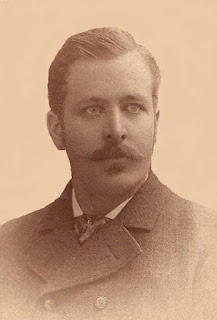
William Allen Cross


[David Randall < Mary Welch < Rex Welch < Lucinda Putman < Catherine Kennison < Mary Ann Cross and her brother William A. Cross]


Tuesday, February 11, 2025

Home

When his wife left him in the summer of 1887, Great-Great-Grandpa William Randall found himself alone with three small children raise —ages 3, 6, and 8. With no choice but to sell his farm, he moved his young family into this house on his younger brother George's property in the tiny village of Mesick, Wexford County, Michigan. (See previous blog entry for the intriguing story of his failed marriage.)

I'd love to know if anyone has ever been to Mesick. I haven't, but it’s on my bucket list. With a current population of under 500, I imagine it’s one of those blink-and-you’ll-miss-it kind of towns!

Despite growing up in severe financial hardship, my great-grandfather, Claude Walter Randall, refused to let his circumstances define his future. Through sheer determination and perseverance, he put himself through college, eventually earning a Master’s degree in philosophy from Stanford University. He went on to become a professor and prominent school administrator in Southern California, breaking the cycle of poverty that had long burdened our family.

More than sixty years after my grandfather and his sister were sent from the comforts of their upper-middle-class Southern California home to visit their grandparents for a summer in the late 1920s, they still vividly recalled—long after most other childhood memories had faded away—the shock of having to sleep on mattresses stuffed with cornhusks. It was a stark reminder of how far the family had come in just one generation.

Every time I look at this photo, I feel a deep sense of gratitude and admiration for the resilience of those who came before me.

That's William and Phebe #2 on the right. 
Not sure yet who the others are. 

[David M. Randall < Bruce W. < Randall < Louis K. Randall < Claude W. Randall < 
William A. Randall]


Grandma Phebe's Surprise!

For years, I believed my great-great-grandparents were William and Phebe Randall. They married on December 26, 1875, in Oneida, Eaton County, Michigan. Phebe was just seventeen, William twenty-three. Phebe's childhood had been marked by loss—her mother, Sophronia, died when she was eleven, and her father, Orison Mosher, passed away five years later from injuries sustained in the Civil War, just months before her wedding. The skies may have been clear on their wedding day, but the temperature hovered near zero—perhaps a chilling foreshadowing of the marriage that was to come.

William and Phebe had three children: Claude Walter (my great-grandfather) and his sisters, Frantie and Lena. As a young man, Claude left home to attend college, later moving west to Phoenix and then to Ontario, California, where he became a school administrator. My grandfather and his sister Dolly grew up in Ontario, more than 2,000 miles from their grandparents' home in Michigan. Travel was arduous in the early 1900s, yet the family did manage to visit their Michigan relatives on at least one occasion. When I interviewed my grandfather and Aunt Dolly in the 1990s, their childhood memories had faded, but one thing remained clear to both of them: Grandma Phebe was a warmhearted woman who treated everyone with love and kindness.

So imagine my shock when I received an email from a fellow genealogist, informing me that my great-great-grandmother, Phebe Mosher, was actually his great-great-grandmother, Phebe Mosher. And that her married name wasn’t Phebe Randall, but Phebe VanNortrick!

According to his research, Phebe Mosher had married Almiron VanNortrick in 1887 and had three children with him in Ionia County, Michigan. He had a copy of a death certificate for a Phebe Van Nortrick, daughter of Orison and Sophronia Mosher, who had died in 1894 at the young age of 35. This made no sense as I had documentation showing that Phebe Randall, daughter of Orison and Sophronia Mosher, had lived until 1933, passing away at age 71.

Could there have actually been two Phebes born in 1858, in Michigan, each to a different Orison and Sophronia Mosher? Somehow that seemed unlikely!

I turned to my grandfather and Aunt Dolly for clarification. When I mentioned the possibility that Grandma Phebe had once left her family, my great aunt suddenly recalled something she had heard her parents talk about many years before. "I remember my father talking about how his mother just up and left one day." Grandpa nodded, visibly uncomfortable. "The children could do nothing but watch as their mother stormed across the cornfields, never to be seen again."

"But," I reminded them, "she was seen again—you visited her as children."

They hesitated., then recalled with smiles, "that certainly was a wonderful summer. She was such a sweet woman."

Something certainly didn’t add up. Could it be possible that Grandma Phebe had abandoned William and the children, remarried, had three more children, and then somehow returned to her original family years later? It was a bizarre scenario, but at this point, I was ready to believe almost anything.

My next move was to contact the Eaton County Courthouse. The response came quickly. Fascinated by the mystery, the clerk journeyed to the basement archives and found something remarkable: Phebe had filed for divorce from William not once, but twice! For reasons unknown, the first attempt, just two years into the marriage, didn’t go through, but the second was finalized ten years later, in 1887, leaving William with three children ages 3, 6, and 8. She married Almiron VanNortrick just two days after the divorce was finalized.

So did she die at 35 or 71? The answer is both!

In 1900, William married his second wife, whose name just happened to also be named Phebe—a divorced woman with four children of her own. This was the woman my grandfather and Aunt Dolly knew as "Grandma Phebe" and remembered so fondly.

For years, the two Phebes had been conflated into one. One Phebe had fled an unhappy marriage, remarried, and died young. The other stepped into her place and raised a family that never questioned her identity. The truth had been buried beneath mistaken assumptions and the peculiar coincidence of identical names.

May this story of the two Phebes serve is a reminder that just when you think you have everything figured out, the past has ways of surprising you.


Phebe (Mosher) Randall VanNortrick

[David M. Randall < Bruce W. Randall < Louis K. Randall < Claude W. Randall < 
William & Phebe (Mosher) Randall]


Friday, January 31, 2025

Mary Ann Cross: A Life Defined by Challenges

Our family trees are full of ancestors who faced unfathomable challenges. My 3rd-great-grandmother, Mary Ann Cross is one such ancestor. The hardships she endured would have broken many, yet she pressed on, carving out a life of independence, resourcefulness, and resilience.

From Ohio Farm Girl to Iowa Pioneer

Born on May 21, 1838, on her family's farm in Pickaway County, Ohio, Mary Ann Cross spent her early years surrounded by the challenges of rural life. In 1843, when she was still a small child, her family embarked on a journey westward to Iowa City, a raw and untamed frontier settlement that had just been designated the capital of the Iowa Territory. By the time Iowa achieved statehood in 1846, the Cross family had pushed even further north to Jones County, where they continued their pioneer existence, forging a life in a land of both opportunity and hardship.

As the eldest of nine children, Mary Ann's childhood was defined by responsibility and labor. Growing up on the family farm, hard work was not just expected—it was essential. In addition to the daily demands of frontier life, she likely played a central role in helping her mother care for her younger siblings, balancing childcare with the endless household chores that were part of survival on the prairie.

Marriage, Motherhood, and Betrayal

In 1857, at just 19 years old, Mary Ann married Henry Kennison, an illiterate farmer with a modest personal estate of $140. Together, they had three daughters: Catherine, Marion, and Rose. Though life on the farm was challenging, they managed to get by. Then, in 1861, the Civil War called Mary Ann’s father to serve, leaving her to care for her mother, her younger siblings, and an aging grandmother. Meanwhile, Henry, who did not serve, struggled to provide stability for his growing family.

In 1869, Mary Ann’s world was upended. Although the exact circumstances remain unclear, Henry was sent to prison for bigamy, a shocking betrayal that left her with little choice but to file for divorce—an act heavily stigmatized at the time. With her husband gone and his financial support presumably lost, Mary Ann was forced to place her daughters in the Veteran’s Orphans Home in Glenwood, Iowa. Now a divorced, single mother in a time when few options existed for women on their own, she faced an uncertain and daunting future.

A New Start in Nebraska

Knowing that she needed to start fresh, Mary Ann took the bold step of moving west to Seward County, Nebraska, where land was still available under the Homestead Act. On April 29, 1870, she married Lorenzo Dow Breakman, a Civil War veteran, and together they established a home on 160 acres of homesteaded land.

In 1877, the couple suffered a heartbreaking loss when their only child, John Leslie, died at just nine months old. Still, Mary Ann persevered, helping to raise Lorenzo’s two sons from his first marriage while working tirelessly to build their life in Nebraska.

Caretaker, Matriarch, and Independent Woman

By 1900, Mary Ann had once again taken on the role of caretaker—this time for both her now-disabled husband and her 84-year-old widowed mother. Lorenzo was receiving a small pension due to his failing health, but it was Mary Ann who kept the household running.

After Lorenzo passed away, Mary Ann reclaimed her independence. By 1910, she was living alone at 133 Elm Street, a home she owned free of mortgage—a remarkable achievement for a woman of her time. She had not only survived but had managed to accumulate real estate and financial security.

Love and Loss in Later Years

At the age of 75, Mary Ann wed for the third time, marrying George C. Lothrop in 1913. That year, she owned two homes valued at $7,500, along with additional personal assets. She was no longer the struggling young mother who had once been abandoned by a husband in prison—she was now a woman of means.

However, the years eventually did catch up with her. In her final years, Mary Ann became an invalid, spending the last six months of her life confined to bed. She passed away on July 17, 1921, at the age of 83, with the official cause of death listed simply as “old age.” She was buried beside her second husband, Lorenzo, and their infant son in Nebraska.

Mary Ann (Cross) Kenison Brakeman Lothrop 

Mary Ann Cross’s life was shaped by hardship, yet she met every challenge with determination and resilience. She endured betrayal, divorce, financial struggles, the loss of a child, and the responsibilities of caring for multiple generations of family members. Yet, through it all, she emerged as an independent woman who lived life on her own terms.

Her story is one of strength, survival, and reinvention, and as I continue to uncover more about her remarkable life, I am reminded that we are all shaped by the struggles and triumphs of those who came before us.

[David Randall < Mary Welch < Rex Welch < Lucinda Putman < Catherine Kennison < 
Mary Ann Cross]

Monday, January 27, 2025

Remembering Grandpa Rex

My grandfather died when I was just six years old, leaving me with only the faintest of memories. He lived out of state, and my encounters with him were few. Complicating matters, my grandparents divorced when my mother was still a small child, and her relationship with her father was estranged. My mother rarely spoke of Grandpa Rex, so much of what I now know about my him has come about only through my genealogical research.

The photo below was taken some time during the Holidays, 1970. That’s me in the red, sitting to my grandpa’s left. The girls are my younger sisters. Grandpa Rex had come to California from Colorado for a visit. Amazingly, I still have some vague memories of that day. I remember him as a large, pipe-smoking man who, to my young mind, exuded the rugged air of a mountain man. That impression was likely enhanced by the gift he brought me during that visit: my very own Davy Crockett coonskin cap. That cap became one of my most cherished possessions, and more than half a century later, it still sits proudly on display in my den.

My next memory of Grandpa Rex was my mother packing for his funeral. I never saw him again.

Rex Lowell Welch was born on April 12, 1915, in the small rural community of Clarks in Merrick County, Nebraska. He was the only child of Joseph William and Lucinda Catherine (Putman) Welch. Around 1927, Rex and his parents relocated from Nebraska to Fort Collins, Colorado, where his father served as a city police officer.

Rex attended the local public schools and was later a student at the University of Colorado in Boulder, when he met my grandmother. They were married in 1937, and by 1940, had moved to Southern California for reasons I have yet to uncover. Rex worked as an engineer, initially employed by the Union Oil Company of California (Unocal). My uncle Doug was born in August 1940, followed by my mother in February 1945.

On May 5, 1945, Rex enlisted in the United States Army Air Corps and was sent Wright Field in Ohio. There, he worked as a project engineer, structural integrity, on the B-29 bomber. While I have not yet obtained his military records, uncovering details about his service is high on my to-do list. I know little about his time in the military, although it does not appear he was ever sent overseas and thus would not have seen combat. What I have been told, is that returned a changed man home a changed man. Family lore - admittedly biased - has painted him as a womanizer and an alcoholic, and perhaps he was—but as with all of us, the headlines tell only part of the story.

By the 1950s, my grandparents had divorced. Rex would marry and divorce two more times after that. I do know that he worked for a time at Consolidated Engineering Corp. in Pasadena, a chemical instrument manufacturer founded by Herbert Hoover Jr., and later as an engineer for William Miller Scientific Instruments, also based in Pasadena. Beyond that, his life remains a mystery to me.

At some point, Rex returned to Colorado, though I do not know when or why. He was living there when he passed away on July 27, 1971, at just 56 years of age. The cause of death was an undiagnosed glioblastoma - an aggressive brain tumor.

My Coonskin Cap (age 54)

I don’t know much about the kind of man my grandfather was. I don’t know the root of his marital troubles or why he struggled as a father to my mother. I don’t know how the war shaped him or the role it played in his drinking. But I do know this: one day, when I was just a little boy, he drove all the way from Colorado to see me and he brought me a coonskin cap. That means he loved me, and I have always loved him back. 

[David M. Randall > Mary C. Welch > Rex L. Welch]


Wednesday, January 22, 2025

Don’t Overlook the Years In Between


In April 2042, just seventeen short years form now, I’ll appear in the available United States Federal Census records for the very first time. That year will mark the release of the 19th Decennial Census of the United States, covering the year 1970. I was five years old then, living with my parents and little sister in a quaint, Mayberry-like suburb of Los Angeles called Temple City. My late mother was then just 24 years old; my father only 29. Ten years later, at age 15, the 1980 census will find me still in Temple City, but by then our family had moved to a larger home in order to accommodate the arrivals of another sister and my little brother.

The 1980s were some of the best years of my life. In 1983, I graduated high school and left for college, heading as far north as possible without actually leaving California. How I loved hiking the trails of the Redwood Forest, backpacking in the Trinity Alps, and meditating on the shores of the Pacific Coast as the sun set on the horizon. Those years were formative for me—a time of discovery, growth, and independence. But none of that will show up in census records.

I had once seriously contemplated becoming a forest ranger, until health issues got in the way. As the decade came to an end, I landed an amazing job back in Los Angeles and I temporarily moved back home while I adjusted to the transition. And that’s what the 1990 census will show: “Still living at home with Mom and Dad.”

In the years that followed, I started a business, purchased a home, and built a family. The 1990s were prosperous years, but they were also tumultuous. In 1992, I witnessed the Rodney King riots—tanks rolling down my suburban street and soldiers with military rifles standing guard at the corner market. In 1994, I huddled on my bathroom floor as the Northridge Earthquake nearly destroyed my home. In 1997, I suffered my first heart attack and learned that my kidney disease had come out of a seven-year remission. By the end of the ’90s, I was burned out, so it seemed fitting that the world would be soon be ending with Y2K.

Of course, the world didn’t end—and neither did my struggles. In 2000, on the verge of losing my mind, I moved back home temporarily to regroup. But the 2000 census won’t reveal that. It will simply say, “Still living at home with Mom.”

Surprisingly, the 2000s turned out to be a good decade. I resolved the conflicts at work, found a sense of calm at home, and expanded my business threefold. By the decade’s end, my boys were grown, and I became a first-time grandpa. But my health still weighed on me, and I was tired. My mother had moved to Texas to be closer to family, and by the close of the decade, I was ready to join her. So, I sold my business, pocketed the cash, and relocated to Dallas. Yet once again, the census will fail to capture the entire story. It will only say, “Moved to Texas—still lives with Mom.”

One hundred years from now, future genealogists may look at the census records for 1970, 1980, 1990, 2000, and 2010 and draw a single, misleading conclusion: David spent nearly his entire life living with his mother.

So let my story serve as a lesson. Census records are valuable, but they can distort the story if relied on too heavily. They capture fleeting moments, but ignore the thousands of experiences in between. So as you explore the lives of your ancestors, be careful not to overlook the years in between as that’s where you’ll find the secrets and the stories that made each of them who they truly were.

Thursday, January 16, 2025

What's in a (Nick) Name?

When I first saw this month’s topic, "Nicknames," I thought I might have to sit this one out. I’ve never had a nickname. My siblings never had nicknames. My parents never had nicknames. Even as I expanded my search to aunts, uncles, cousins, and beyond, I still came up empty-handed. It seemed like nicknames just weren’t a thing in my family. But, as it turns out, there’s one major exception to that rule.

My mother’s father was one of eight children—six older brothers and one younger sister. And for some reason, most of them answered to names entirely different from the ones they were given. For instance, take my grandfather, who we called Papa. He was born Jack Maddox Meyers, but somewhere along the line he decided to call himself “Jack Patrick”, believing it sounded more Irish—a curious choice given that he was of mostly German descent.

Two of his brothers passed away before I was old enough to remember them, but the others all had nicknames that stuck out like sore thumbs. Paul Roy? We called him “Uncle Buster”. Glen Edward was known as “Curly” – although by the time I knew him he was completely bald! Robert Thomas went by “Ellsworth,” a name whose origin remains an enigma to me. Henry was known as “Wes”. And then there was their little sis, Marie B. Meyers, who somehow came to be known as “Jean T.” I’m not even sure where to begin unraveling that mystery.


This is an image of Alice Meyers and five of her children, taken about 1927 in Falls City, Nebraska. That's Papa in the front, next to his sister Marie (later Jean). I'm not sure which of his six brothers the other boys are. 

[David M. Randall < Mary C. Welch < Leona C. Johnson m. Jack P. Meyers]


Great-Grandma Alter's Secret: She wasn't an orphan.

My great-grandmother, Helene (Herline) Alter , claimed to be an orphan—but that wasn't exactly true! Helene was born in 1886 in Hoboken...